Meeting minutes
Minutes record what happened at a meeting. Writing something in the minutes does not amend the Declaration, Articles or Bylaws.
Community
A plain-language guide to our governing documents, HOA terms, and how decisions are made.
The answer depends on the subject, but lower-level rules cannot contradict higher authority.
The declaration and articles address different kinds of authority, so neither is a universal substitute for the other.
Brighton Forest's Bylaws expressly say that the Articles and Declaration control whenever either conflicts with the Bylaws. See Bylaws, Article XII.
What each document does, what it does not do, and what Brighton Forest must do to change it.
The Declaration is the recorded document that places restrictions and obligations on Brighton Forest lots.
It "runs with the land," which means it binds later owners because it is tied to the property, not because each buyer personally signed it.
The Articles created Brighton Forest Community Association, Inc. as a North Carolina nonprofit corporation.
They establish its legal name, purpose, membership, voting rights, board-size range and basic corporate powers.
The Bylaws explain how the Association conducts its internal business.
If the Declaration tells you what property restrictions exist, the Bylaws tell you how the organization meets, votes, elects directors and keeps records.
Policies and Rules and Regulations are decisions adopted by the Board under authority granted by the Bylaws.
They can explain how the Board conducts Association business, but they cannot create powers the Board was never given.
Usually by a majority vote of directors present at a Board meeting with a quorum. Published rules and amendments must be provided to owners and occupants.
The architectural and landscape guidelines give homeowners and the ARC more detailed standards for exterior changes.
They operate under the Declaration's architectural-control provisions and the Board's rulemaking authority.
They are not the Declaration, Articles or Bylaws, and they are not recorded with each lot's title.
By Board action under its rulemaking and delegated architectural-review authority. Any amendment must remain consistent with state law, the Declaration, the Articles and the Bylaws.
They may document a decision, but they do not have the power to amend a higher document.
Minutes record what happened at a meeting. Writing something in the minutes does not amend the Declaration, Articles or Bylaws.
"We have always done it this way" is not a source of authority. A repeated practice still has to comply with the governing documents and law.
The management company is the Association's agent. It carries out authorized decisions; it cannot replace the Board, rewrite the documents or override state law.
Words that are often treated as interchangeable, even though they mean different things.
Robert's Rules of Order Newly Revised is the meeting procedure manual that applies when state law and the Bylaws do not provide a different procedure.
North Carolina law says Association and Board meetings use the most recent edition of Robert's Rules unless the Bylaws provide a different procedure. Brighton Forest's Bylaws do not adopt a different parliamentary manual.
Motions, seconds, debate, amendments, voting, points of order, election procedure, announcing results and other steps needed to conduct an orderly meeting.
It cannot override state law, the Declaration, the Articles or the Bylaws. It cannot expand the Board's authority or make an unauthorized action valid.
A specific requirement in state law or Brighton Forest's governing documents controls. Robert's Rules fills the procedural gaps that those authorities leave open.
A Point of Order is the formal procedure a member uses when the member believes a meeting is violating an applicable rule.
It calls on the chair to identify the governing rule, make a ruling and enforce the correct procedure.
It is not a speech, a debate or a vote on the underlying issue.
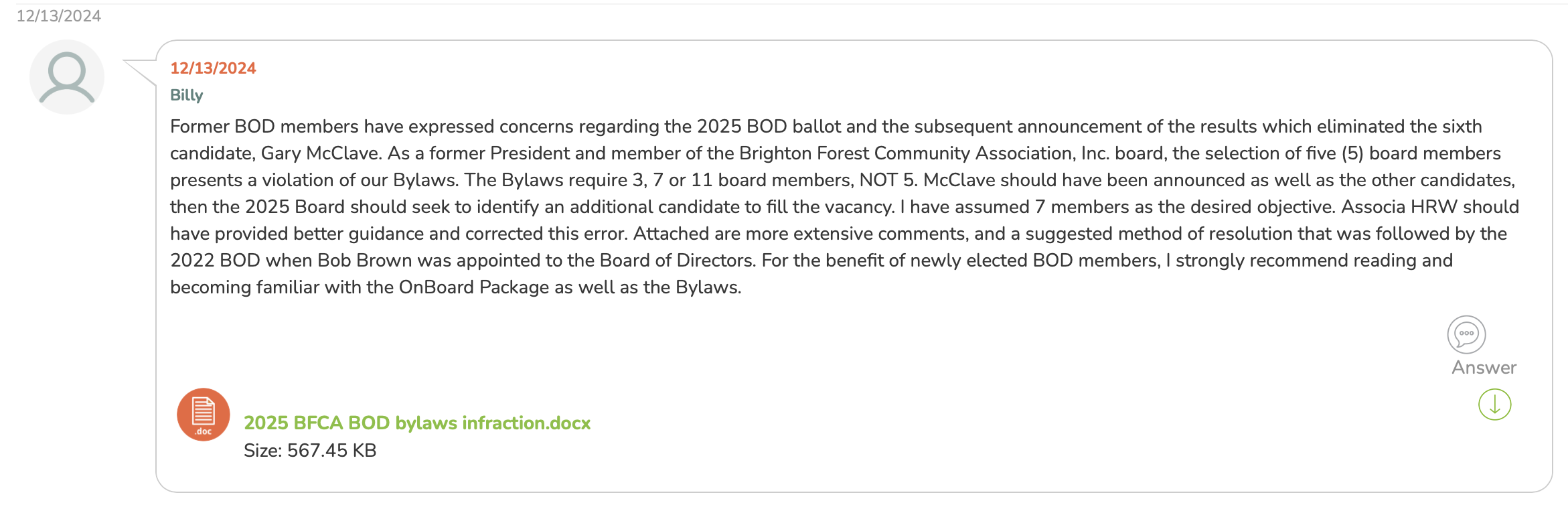
Former board member and president Billy Oliver posted a TownSq concern and attached a document titled “Point Of Order.”
He identified the Bylaw provisions he believed the 2025 board ballot and announced results violated, explained the alleged error and requested that it be corrected.
That is what a Point of Order is for: identifying a specific departure from the rules and requiring it to be addressed.
This example demonstrates the procedure, not agreement with every conclusion in the attachment. The document separately assumed a January director transition, but no governing authority establishing that later date has been identified.
Scott Farwell likewise raised a Point of Order at the October 15, 2026 annual meeting concerning the election process.
Raising it was the procedure Robert’s Rules provides when a member believes the meeting has departed from the governing rules.
It formally placed the issue before the chair for a ruling; it was not an interruption outside the meeting process.
Sources: Robert’s Rules of Order Newly Revised, 12th ed., §23:1 and §§23:12–16; N.C.G.S. §47F-3-108(c).
"Except as otherwise provided in the bylaws, meetings of the association and the executive board shall be conducted in accordance with the most recent edition of Robert's Rules of Order Newly Revised."
N.C.G.S. §47F-3-108(c)
This is the process established by the Brighton Forest governing documents and current North Carolina law.
The annual meeting is held at 7:00 p.m. on the third Thursday of October.
Written notice must state the time, place and agenda and be delivered or mailed to each person entitled to vote 10 to 50 days before the meeting.
Brighton Forest Bylaws, Article IV §§2 and 6. Read the source
Quorum is measured at the beginning of the meeting. Homeowners count toward quorum whether they attend in person or are represented by proxy.
Brighton Forest Bylaws, Article IV §7. Read the source
A proxy must be written, signed and dated. The person appointed as proxy does not have to own a lot.
Under current state law, a proxy expires after 11 months unless it states a shorter period.
A homeowner can revoke it by giving notice, delivering a later proxy, or attending and voting in person.
Articles of Incorporation, Article VI; Bylaws, Article IV §§8-9; N.C.G.S. §47F-3-110; N.C.G.S. §55A-7-24
There is no cumulative voting. The candidates receiving the highest numbers of votes fill the available Board seats.
Brighton Forest Bylaws, Article IV §10 and Article V §4. Read the source
North Carolina law makes the current edition of Robert's Rules the default meeting procedure unless the Bylaws provide otherwise. Under that procedure, the tellers report the count and the chair declares the result.
N.C.G.S. §47F-3-108(c); Robert's Rules of Order Newly Revised §45:39. Read the source excerpt
Board members take office upon election. No governing authority establishes January 1, December 31, or any other later transition date.
The Bylaws require a regular Board meeting immediately after the annual meeting at the same place.
At that meeting, the Board can elect its officers.
N.C.G.S. §47F-3-103(e); Bylaws, Article VI §2 and Article VII §2. Read the Bylaws
No. Brighton Forest requires signed approval from owners of at least 75% of all lots and a recorded amendment.
No. The current Bylaws require approval from voting members holding at least 67% of all voting interests and recordation of the amendment.
Yes, through properly conducted Board action, but the change must stay within the authority granted by the higher documents and law.
No. Calling something a guideline does not give it more authority than the law or the governing document from which it comes.
No. Minutes can prove that a vote occurred, but they cannot replace the approval and recording steps required to amend a governing document.
No. Homeowners elect the directors. The directors then elect the Association's officers, including the president.
Yes. State law allows the Association to amend budgets, so a new board may propose a replacement and follow the required notice and ratification process.
Homeowners do not approve a budget with a 51% affirmative vote; it is ratified unless the applicable rejection threshold is met, and no quorum is required.
For assessment increases, the Declaration requires:
This page is a plain-language reading guide, not a substitute for the documents and not legal advice. If a summary conflicts with a source, the governing document or statute controls.